
Fiber Laser Marking Machines
Fiber laser marking machines put a permanent mark on metals and many engineering plastics at 1064 nm. We supply 20W to 100W systems with sources from IPG, JPT, Raycus or MAX, in seven formats: desktop, portable, handheld, fly (inline), gold/hallmarking, enclosed cabinet, and enclosed marking chamber.
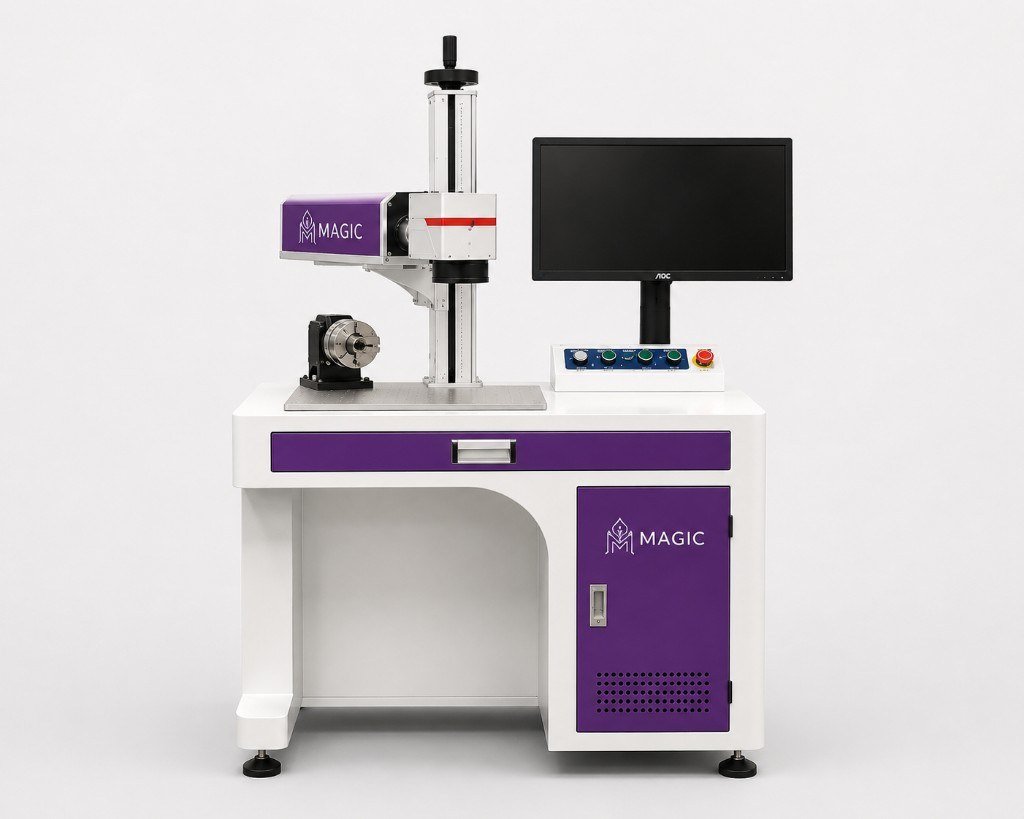
Who this family is for
Use fiber when the part is steel, stainless, aluminium, brass, copper, titanium, carbide or a markable engineering plastic — serials, QR, logos and traceability. It is the default industrial metal marker.
It is the wrong first choice for heat-sensitive plastics and PCBs, for wood/acrylic cutting, and for deep stamped IDs that must survive coating or abuse. See UV , CO2 and dot peen .
How it works
A fiber source feeds a galvo scan head. The 1064 nm beam anneals, engraves or foams the surface without ink. Typical software: EZCAD; LightBurn where the controller allows it. Air-cooled on this range — no chiller for standard marking cells.
Formats
-
Desktop (standard)
Repeat jobs at a workstation
Stationary cell. Plug in, fixture the part, mark. Production, assembly or inspection.
View format -
Portable
Move the box between cells or sites
Box-type body. Same fiber process, built to move without a dedicated cabin.
View format -
Handheld
Large, awkward or fixed parts
Gun-style head and compact controller. Take the beam to the part.
View format -
Fly
Moving conveyor / line, no stop
Encoder or photocell trigger. Mark while the line runs. Serial, date, shift in software.
View format -
Gold
Precious metals, hallmarking, jewellery shops
Same wavelength family, set up for gold, silver, platinum and fine jewellery work — not a heavy industrial DPM station.
View format -
Enclosed Fiber Laser Marking Machine
Complete workstation enclosed inside a cabinet/housing
The marking setup sits inside an enclosed machine structure. Not an open desktop, and not a chamber-only enclosure with an external controller.
View format -
Fiber Laser Marking Machine with Enclosed Marking Chamber
Dedicated chamber around the marking zone; controller remains external
The marking head and work area sit inside an interlocked marking chamber. The controller stays outside the chamber.
View format
Enclosed Fiber formats
| Attribute | Enclosed Fiber Laser Marking Machine | Fiber Laser with Enclosed Marking Chamber |
|---|---|---|
| Primary enclosure | Complete machine/workstation | Marking zone only |
| Main structure | Enclosed cabinet/housing | Dedicated chamber around marking area |
| Workstation enclosed | Yes | No |
| Marking area enclosed | Yes | Yes |
| External controller | May be integrated or accessible on the cabinet | External |
| Physical format | Full enclosed machine | Chamber-based marking workstation |
Desktop and both enclosed Fiber formats can be configured with options such as integrated AC and fume extraction depending on the installation. Those options are not separate machines.
Family specs (range)
Model pages list speed, field and extras for that format. Do not treat this table as one SKU.
| Parameter | Value |
|---|---|
| Wavelength | 1064 nm ± 5 |
| Power | 20W / 30W / 50W / 100W |
| Sources | IPG / JPT / Raycus / MAX |
| Typical field | 70×70 mm to 500×500 mm (lens-dependent) |
| Cooling | Air-cooled |
| Software | EZCAD (standard); LightBurn where supported |
| Voltage | AC 220V, 50/60 Hz |
| Source life | Up to 100,000 hours typical, source and duty cycle dependent |
Industries
Applications
- Serial, QR and traceability
- Jewellery marking and hallmarking
- Inline laser marking
- VIN and chassis marking
Supplied from Coimbatore to plants across South India. Locations · Coimbatore
FAQs
- Fiber vs UV?
- Fiber for metals and many hard plastics. UV when the part cannot take heat — including many PCBs.
- Fiber vs dot peen?
- Fiber for contrast and fine codes without impact. Dot peen for deep, indented IDs.
- Which wattage?
- Set after we see material, depth and cycle time — often via sample marking.
- Will it mark every metal?
- Most engineering metals yes. Coatings and mirrors need a trial.
Tell us the metal (or plastic), the code or logo, and whether the part comes to a bench, a gun, or a line.